
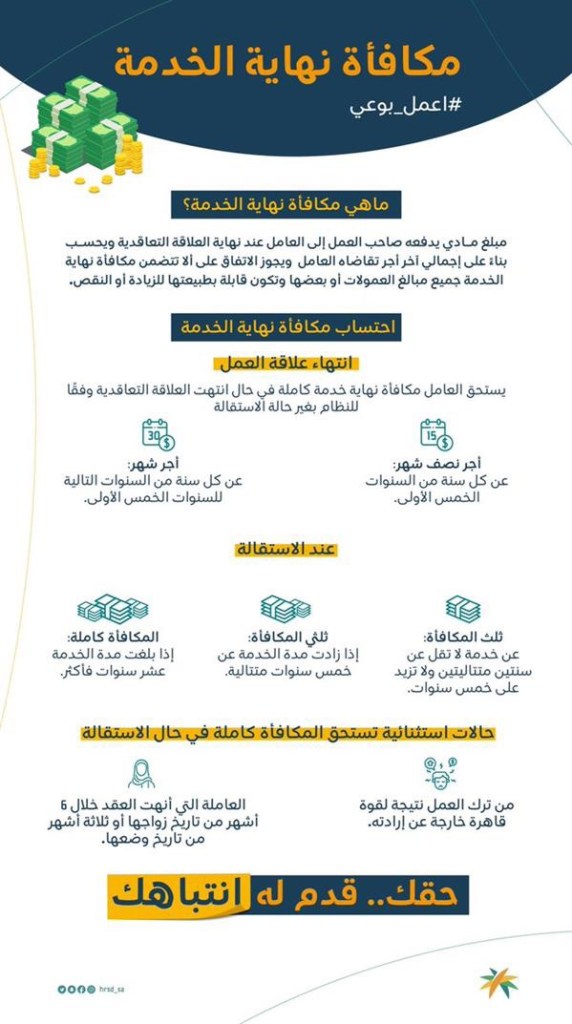
The Ministry of Human Resources and Social Development explained that the end-of-service indemnity is a material amount paid by the employer to the worker at the end of the contractual relationship, indicating that it is calculated based on the total last wage received by the worker.
The ministry pointed out that it is permissible to agree between the worker and the employer, provided that the end-of-service indemnity does not include all or some of the amounts of commissions, and is inherently subject to increase or decrease.
She pointed out that the worker is entitled to a full end-of-service indemnity if the contractual relationship ends in accordance with the system without the state of resignation, pointing out that at the end of the contractual relationship, half a month’s wage is calculated for each of the first five years, and one month’s wage for each of the years following the first five years.
She pointed out that upon resignation, the worker receives one-third of the reward for a service of not less than two consecutive years and not more than 5 years, two-thirds of the reward if the period of service exceeds 5 consecutive years, and the full bonus if the period of service reaches 10 years or more.
She added that there are exceptional cases that deserve full reward in the event of resignation, including who left work as a result of force majeure beyond his control, and a worker who terminated the contract within 6 months from the date of her marriage or 3 months from the date of placement.















 Storya Ni Juan Official