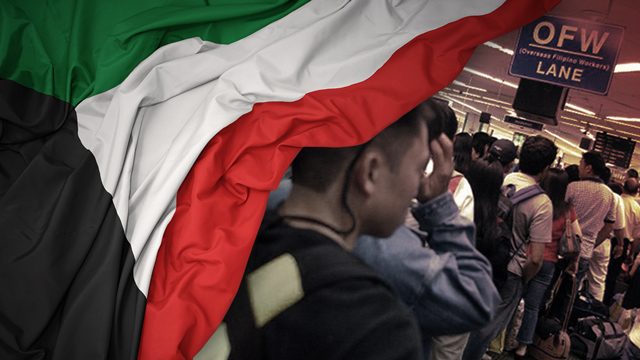
Mayo 30: Kasunod ng paglikas sa isang silungan ng mga manggagawang Pilipino sa lugar ng Al-Surra, na kinaroroonan ng 462 Pilipino, nagpasya ang Ministry of the Interior na i-deport ang 302 na Pilipino.
Ang mga indibidwal ay inilipat sa shelter center sa Jleeb Al-Shuyoukh, sa ilalim ng Ministry of the Interior, kung saan na-verify ang kanilang impormasyon. Kasunod nito, 232 sa kanila ang nakatakdang i-deport, habang 150 Pinoy ang nakakulong sa center dahil sa travel restrictions na inilagay sa kanila.
Ang proseso ng pagpapaalis ay isinagawa sa koordinasyon sa pagitan ng Ministry of Manpower at ng Residency Affairs Investigations, na may paunang abiso sa embahada ng Pilipinas, ulat ni Al Rai.
Nabatid na ang shelter center, na inuupahang bahay ng embahada, ay lumalabag sa mga batas at regulasyon, na nagsisilbing kanlungan ng mga domestic worker na tumatakas mula sa kanilang mga sponsor.
Kasalukuyang hawak ng Ministry of the Interior ang 150 Filipino sa shelter center dahil sa iba’t ibang kaso laban sa kanila, kabilang ang mga criminal offense, misdemeanors, at labor disputes.
Magsasagawa ng pagtutulungang pagsisikap kasama ang Ministri ng Hustisya at ang Ministri ng Manpower upang mapabilis ang mga kinakailangang pamamaraan para sa kanilang pagpapauwi sa kanilang sariling bansa.
Ang Ministri ay gumawa ng makabuluhang pagsisikap na magbigay ng pangangalagang pangkalusugan at mga serbisyong logistik sa mga manggagawa alinsunod sa mga internasyonal na kasunduan at makataong pamantayan.
Ang mga pamamaraan sa paglalakbay para sa grupo ng 232 indibidwal, na binubuo ng 223 kababaihan at 9 na lalaki, ay malapit nang makumpleto. Naitatag na ang koordinasyon sa embahada ng Pilipinas, at ipapatapon sila sa mga batch batay sa mga iskedyul ng paglipad simula Huwebes. Ibinunyag ng mga source na mayroong karagdagang 70 miyembro mula sa Filipino community na dati ay nakatira sa shelter.
Ang proseso ng kanilang deportasyon ay isasagawa nang hiwalay sa Sabado, Hunyo 3, pagkatapos makumpleto ang mga kinakailangang pamamaraan at mag-book ng kanilang mga tiket. Ang mga mapagkukunan ng seguridad ay hinimok ang lahat ng mga embahada na sumunod sa mga batas ng Kuwait at pigilin ang pagtatatag ng mga espesyal na silungan para sa kanilang mga manggagawa na tumakas mula sa kanilang mga sponsor.
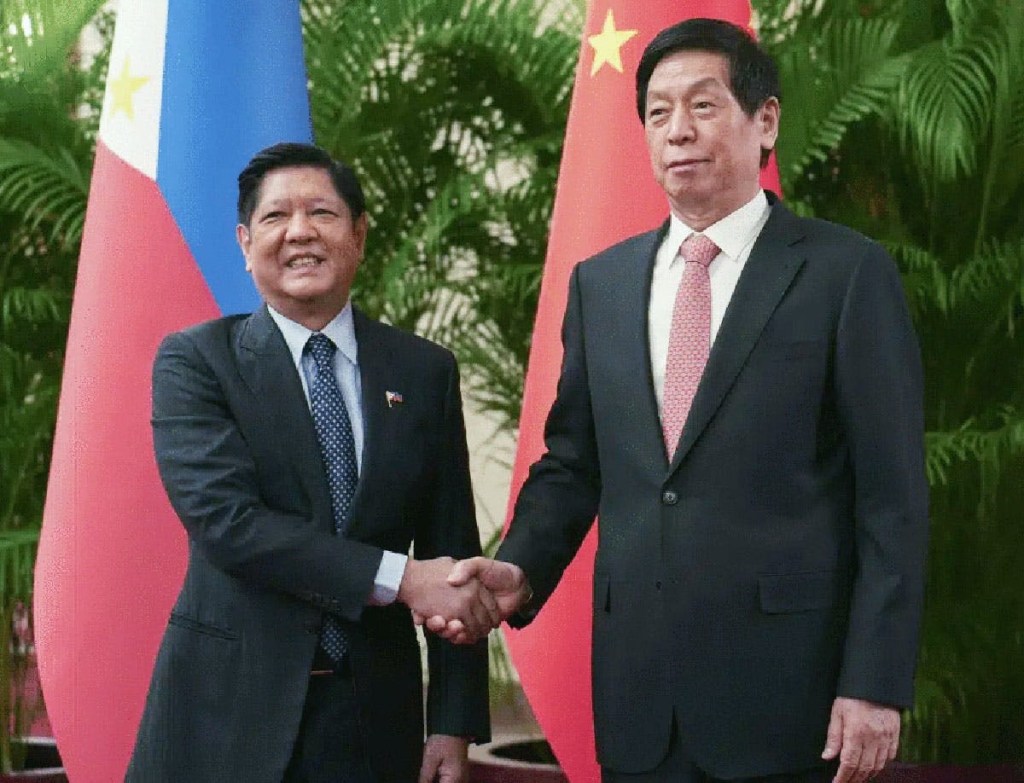
BEIJING – The Philippines and China signed 14 bilateral agreements, including a “direct communication” on the West Philippine Sea, during President Marcos’ three-day state visit here.
An arrangement for the establishment of a communication mechanism on maritime issues was inked between the Department of Foreign Affairs (DFA) of the Philippines and the Ministry of Foreign Affairs of China, according to a statement from the Office of the Press Secretary (OPS).
The Philippines and China signed a joint action plan for 2023-2025 on agricultural and fisheries cooperation between the Department of Agriculture (DA) and China’s Ministry of Agriculture and Rural Affairs, as well as a memorandum of understanding (MOU) on cooperation on the Belt and Road Initiative (BRI).
Launched in 2013 by Chinese President Xi Jinping, the BRI is a global infrastructure development strategy to invest in nearly 150 countries and international organizations, enhancing connectivity and facilitate smoother trade flows between Asia, Europe, and Africa.
Manila and Beijing also agreed on the handover certificate of the Philippine-Sino Center for Agricultural Technology-Technological Cooperation Phase III (PHILSCAT-TCP III).
An MOU was also signed between the two countries between the Ministry of Industry and Information Technology of China and the Philippines’ Department of Information and Communications Technology on digital and information and communications technology cooperation.
The two countries also agreed on a protocol of phytosanitary requirements for the export of fresh durians from the Philippines to China between the DA and China’s General Administration of Customs.
Also sealed was the handover certificate of two China-aid bridge projects in Manila, the Binondo-Intramuros bridge and the Estrella-Pantaleon bridge.
Both countries also agreed on a framework agreement for the Renminbi-portion of the loan financing for three priority projects of the Department of Public Works and Highways (DPWH).
They further sealed four loan agreements for the mixed-credit financing (US Dollar and Renminbi) of three priority bridge projects under the public works department.
The Philippine and Chinese governments also agreed on the implementation of the MOU on tourism between the Philippines’ Department of Tourism and the Ministry of Culture and Tourism of China.
The two countries also sealed an MOU between the Department of Trade and Industry (DTI) and the Ministry of Commerce of China on electronic commerce cooperation; an MOU between the National Economic and Development Authority (NEDA) and China’s International Development Cooperation Agency on the Development Cooperation Plan 2023-2025; and an agreement on economic and technical cooperation between China and the Philippines.
The list also includes a mutual recognition agreement between the General Administration of Customs of China and the Bureau of Customs (BOC) of the Philippines on authorized economic operator program.
Nauna nang nagbabala ang Department of Justice (DOJ) sa mga online lending company na nangha-harass sa paniningil, na maaaring maharap ang mga ito sa kasong kriminal.
Ano ang maaaring gawin ng mga nangutang sakaling harassin ng mga online lending company?
Ayon sa DOJ, puwedeng sumangguni ang mga borrower sa National Bureau of Investigation-Cybercrime Division, Philippine National Police-Anti-Cybercrime Group, National Privacy Commission at Securities and Exchange Commission.
Ano ang mga hindi dapat gawin o maaaring maging paglabag ng mga debt collector o naniningil ng utang?
· Pag-access sa contact list ng mga may utang para padalhan ng mga non-payment message
· Pag-post online ng personal na impormasyon ng mga may utang para hiyain sila
· Pagbabanta sa mga may utang
· Paggamit ng bastos na pananalita
Ang mga nasabing uri ng pangha-harass ay paglabag sa Cybercrime Prevention Act, Data Privacy Act, Revised Penal Code at memorandum circular mula sa Securities and Exchange Commission (SEC).
Ang isang online lending firm na nakakakuha ng hindi awtorisadong pag-access sa contact list ng may utang ay maaaring maging illegal access sa ilalim ng Cybercrime Prevention Act. Ito ay maaaring makulong ng hanggang 12 taon at multa ng hindi bababa sa P200,000.
Ang malisyosong pagsisiwalat o paglalathala ng mga pangalan at iba pang personal at sensitibong impormasyon ng mga borrower na diumano’y tumangging magbayad ng mga utang ay may parusa sa ilalim ng Data Privacy Act. Ang pakikipag-ugnayan sa mga contact list ng nanghihiram ay mapaparusahan din sa ilalim ng parehong batas.
Ang pagsisiwalat ay may parusang hanggang limang taong pagkakakulong at hanggang P1 milyon na multa. Ang labag sa batas na pagpoproseso ng data ay may kulong naman mula isa hanggang pitong taon at maaaring mapatawan ng multa na hanggang P4 milyon.
Ang paggamit naman ng pang-iinsulto o bastos na pananalita at mga banta ng pisikal na karahasan at pananakit ay parehong mapaparusahan sa ilalim ng Revised Penal Code, na maaaring mapataas ang mga parusa sa Cybercrime Prevention Act.
Sa ilalim ng SEC Memorandum Circular No. 18, Series of 2019, ang mga kompanyang nagpapautang at financing company ay maaaring maharap sa multang P25,000 sa first offense, na hanggang P50,000 sa second offense para sa mga lending company.
P50,000 naman para sa first offense hanggang P100,000 sa second offense para sa mga financing company.
MANILA, Philippines — Nasa 6,000 pamilya ng mga Overseas Filipino Workers na naapektuhan ng 7.0-magnitude na lindol sa lalawigan ng Abra ang nakatanggap ng cash aid mula sa gobyerno.
Ipinaliwanag ni Overseas Workers Welfare Administrator Hans Leo Cacdac sa TeleRadyo na ang Department of Migrant Workers ay naglaan ng P20 milyon para sa tulong sa mga apektadong pamilya ng mga OFW na nakarehistro sa kanila.
“Ang hanay ng cash assistance, ayon kay Secretary Toots Ople, at [Labor and Employment Secretary] Benny Laguesma, ay mula P3,000 hanggang P5,000,” sabi ni Cacdac sa Filipino, bagama’t idinagdag niya na ang board of trustees ay nagpapasiya pa rin ng eksaktong halaga.
Matapos humingi ng tulong sa National Disaster Risk Reduction and Management Council, tinukoy nila ang lalawigan ng Abra bilang kabilang sa mga pinakanaapektuhan ng lindol.
“Sa aming unang tally, [naibigay ang tulong sa] 6,000 pamilya sa Abra [probinsya],” dagdag niya.
Ang mga nais mag-avail ng tulong ay maaaring gawin ito online o sa pamamagitan ng walk in, sabi ni Cacdac, ngunit sinabi niya na nagpadala na rin sila ng mga team sa ground para matukoy ang mga kwalipikadong pamilya para sa tulong.
Binigyang-diin niya na ang mga pamilya ng mga aktibong miyembro ng OWWA, o ang mga nagbayad ng mga dues ng ahensya sa nakalipas na dalawang taon, nasa ibang bansa man o nasa Pilipinas ay maaaring makatanggap ng cash assistance.
Naapektuhan ng lindol ang 100,665 pamilya o 381,614 katao sa Ilocos, Cagayan at Cordillera Administrative Regions. Sa mga ito, 1,070 pamilya o 3,781 katao ang nawalan ng tirahan at naghahanap ng pansamantalang tirahan sa 40 evacuation centers.
Nasa 12,637 apektadong pamilya o 46,733 katao ang nananatili sa labas ng mga evacuation center. — Kristine Joy Patag na may mga ulat mula kay Kaycee Valmonte
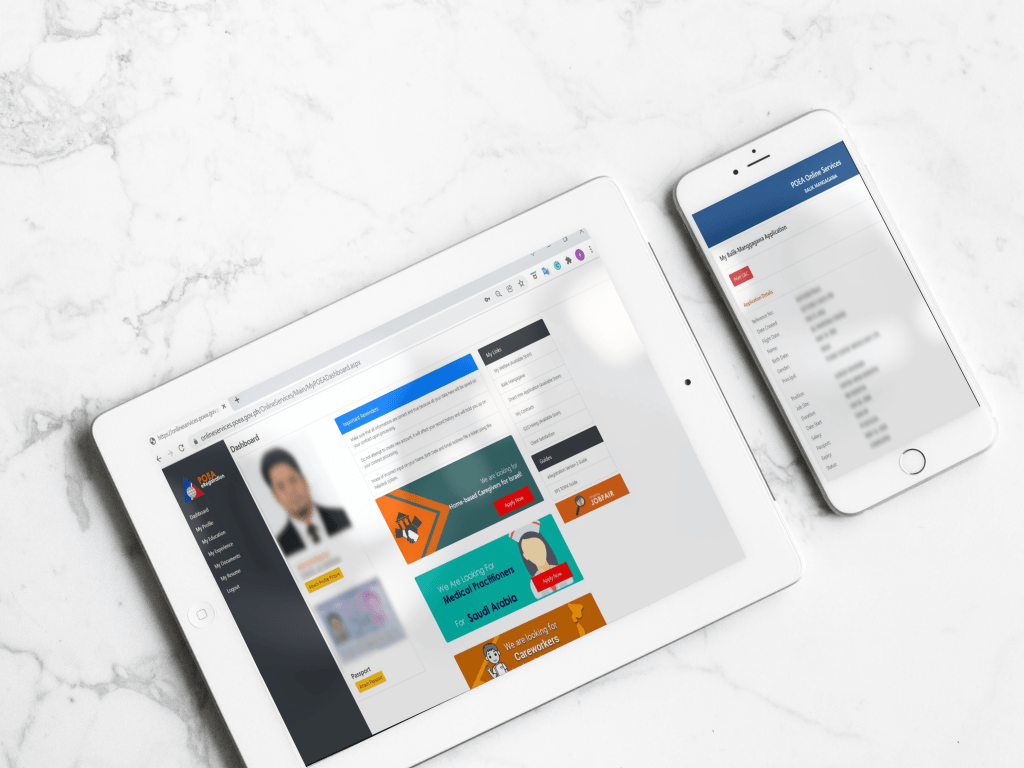
Philippine Overseas and Employment Authority (POEA) releases a new advisory on launching of the new BM Online System replacing the old BM Online system. This new web-based processing system was launched and implemented effective 30 June 2021.
UPDATE: The POEA is now called Department of Migrant Workers (DMW) as mandated by Republic Act No. 11641.
The official name of the new system is POEA Online Processing System for Balik Mangagawa (POPS-BaM) which incorporated the general functionality of the current BM Online System but now uses in-house developed program and addresses the most pertinent problems, bugs and error of the old system.
With this new advisory, BM workers are directed to transfer their existing records under the old BM Online System and transfer them to the new POPS-BaM.
Once the old records have been successfully transferred, POPS-BaM can generate an OEC Exemption to BM Workers returning to the same employer. If the BM Worker will change employer and/or jobsites, the same shall be directed to set an online appointment in order to document the changes in employment data. The system has a built-in feature in the appointment module that helps those who are unable to proceed to avail an OEC Exemption, for the following concerns:
Change of employer and/or jobsite;
Undocumented worker (i.e. status is from tourist to OFW, or dependent to OFW, or student to OFW, etc);
Worker or employer is under watchlist;
OFW is returning to restricted or non-compliant country;
Job position is in the list of Mission Critical Skills
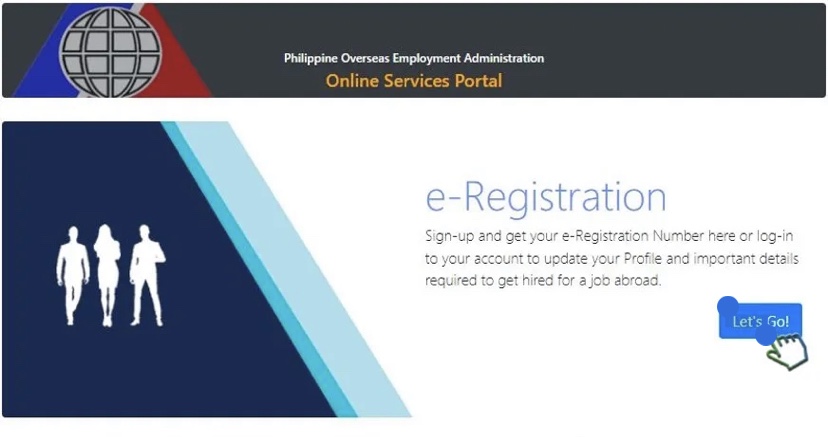
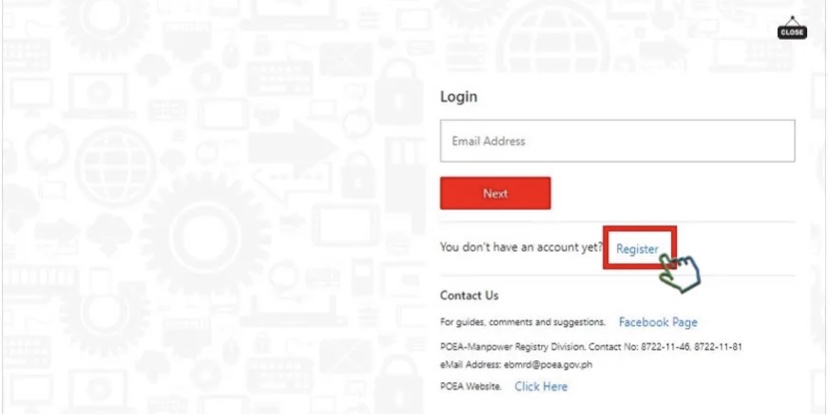
2) A new tab will open. Click the Registerbutton to start to open a new account or log using your username from the old BM Online system. If you login credentials is not working, you can open a new account instead.
Enter your email address
3) Complete the registration and activation of your account to open your new POEA online account. Here is a guide that you can follow:
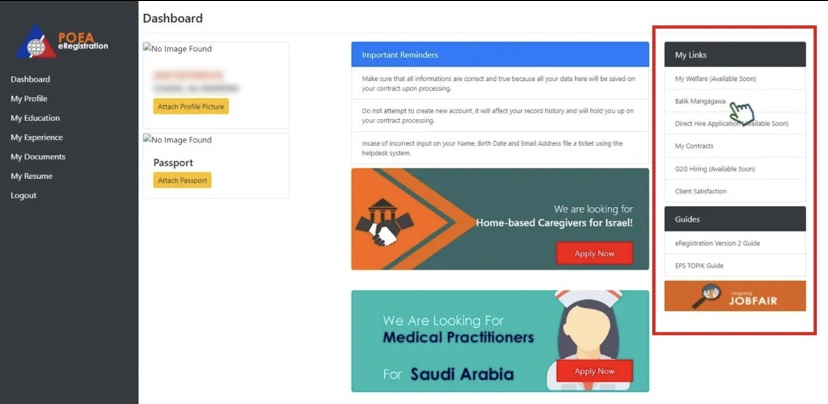
4) Login to your account again using your newly created password. Once you have successfully logged-in, the main dashboard of your account will appear.
On the dashboard, you must attach a profile picture and upload a copy of your passport(1st page) to add it on your profile.
Main Dashboard
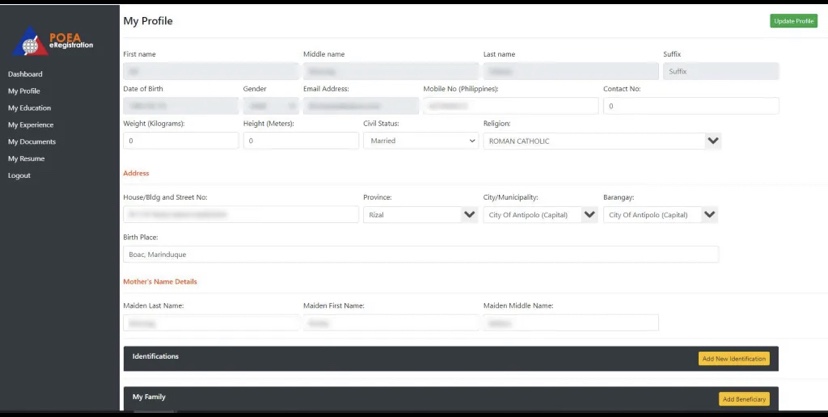
To complete your profile, on the left menu, click the My Profile tab. Enter your personal information, complete address, and Mother’s maiden name.
In addition, for identifications, you can your Passport details and other government ID that is available. And click Add Beneficiary button to add your family members as beneficiaries.
Then, click the Update Profile button on the upper right corner to save changes.
Updated Profile
To transfer your Old BM Records to New Portal. You must transfer it after 2 hours making your Account.
Check Poea Helpdesk on the Main Dashboad and Click Transfer Old Bm Records
5) Now, to apply for OEC or OEC Exemption, click the Balik Mangagawa tab on the right side menu of the dashboard.
Balik Manggagawa Tab
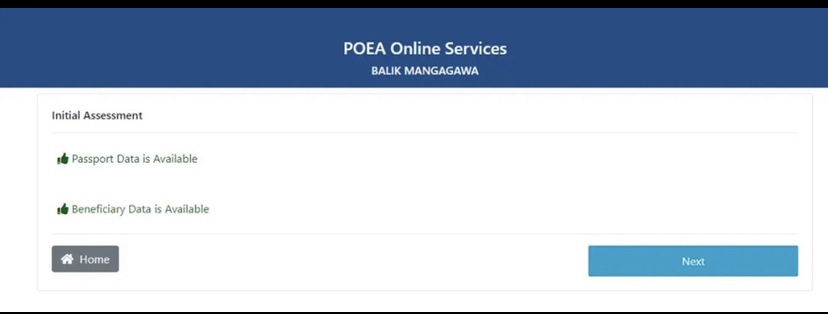
6) As an initial assessment, passport details and list of beneficiary must be updated. If these details are not yet complete, go back to the Home page and go to My Profile tab (left side menu) and update your passport details and enter the name and details of your beneficiaries.
Once the two data becomes available (green color), you can now click the Next button.
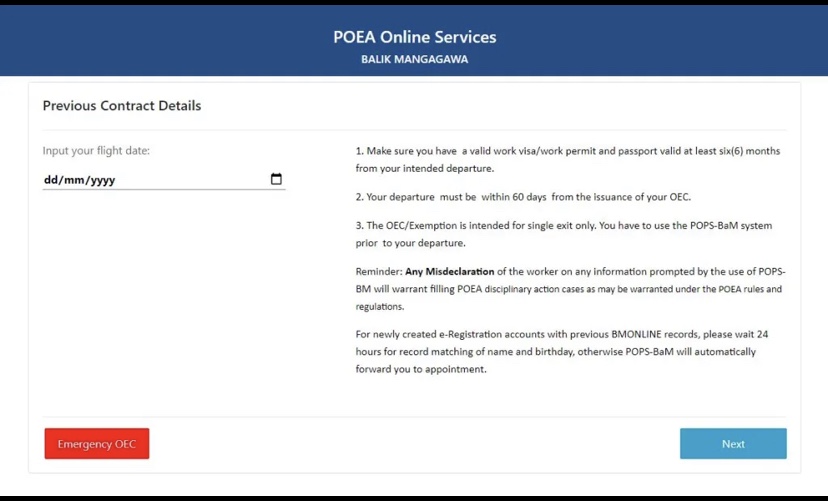
7) Enter your flight date in dd/mm/yyyy format. This flight date, is the date of your departure from Manila or any Philippine airport going to your country destination.
Take note of the reminders on applying for OEC:
Make sure that you have a valid work visa/work permit and passport valid at least six months from your intended departure
Your departure date must be within 60 days from the issuance of your OEC
The OEC/Exemption is intended for single exit only
Then, click the Next button for the next step.
Balik Manggagawa Tab
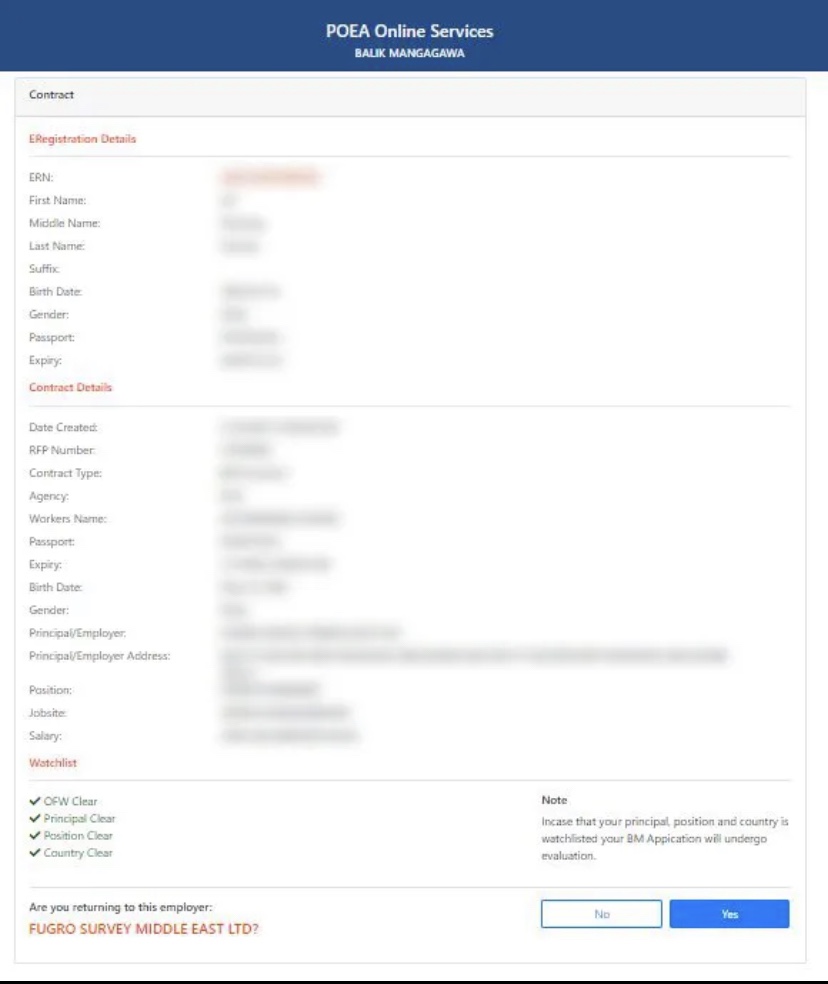
8) On this step, it will show the existing contract that you have in the system. If you are returning to the same country and employer, answer the questions that appear at the bottom of the page.
Balik Mangagawa Contract
9) If you answer “Yes” on all questions, that is, returning to the same employer and country, your OEC details will be displayed. If you want a copy, click the Print OEC button and a PDF copy of your OEC will be available to be saved or printed.
The Philippine Overseas Employment Administration (POEA) said that job seekers are not required to pay the placement fee for some jobs being offered abroad, according to Sandra Aguinaldo’s report on “24 Oras” on Tuesday.
POEA Administrator Bernard Olalia said the zero placement fee is applicable for jobs made available under a government-to-government agreement with some foreign countries.
Olalia said the government is looking at employment opportunities that will soon be available in “emerging markets” such as the United Kingdom, New Zealand, Germany, Canada, Australia, Taiwan, Romania, Croatia, and Hungary.
“Ang Israel ay nagsimula nang mag hire ng ating hotel workers… yung sa Australia isa itong another labor agreement pertaining to healthcare workers. According to them, mahigit isang libong healthcare workers ang kakailanganin natin,” he said.
(Israel started hiring our hotel workers… we have a labor agreement with Australia pertaining to healthcare workers. This will need more than a thousand healthcare workers.)
“Magpapadala rin ang bansang Pilipinas ng mga skilled and professionals natin papuntang Canada,” he added.
(The Philippines will also send our skilled workers and professionals to Canada.)
At the POEA office, several Filipinos bound for abroad were seen preparing for their requirements.
One of them was Frederick Bautista, who will return to South Korea as a worker in a furniture company.
Bautista was unemployed for a year due to the pandemic. But in June, his employer processed his application.
“Medyo malaki-laki po ang sinasahod ko sa ibang bansa. Para sa pamilya at kinabuksan ng mga anak ko.”
(I earn quite a lot abroad. This is for my family and the future of my children.)
Nurse Cyrell Anne de Leon is processing her document to go to Saudi Arabia.
De Leon said he does not want to be separated from her three children, but she has no other choice.
“Para sa future ng mga bata. Ang anak ko tatlo na at lumalaki na,” she said.
(This is for the future of my kids. I have three kids and they’re growing up.)
POEA said job opportunities abroad are opening up as more countries relax their COVID-19 restrictions.
Some of the jobs needed abroad are healthcare workers, factory workers, hotel staff, transportation and aviation staff.
The POEA, meanwhile, advised the public to always check their website for job openings overseas.
It also urged Filipinos to get training and upgrade their skills.
“Katuwang po ng departamento namin ang TESDA para sa patuloy na empowerment through the skills of our OFWs,” Olialia said.
(Our department is partnering with TESDA for the continuing skills empowerment of our OFWs.)—Mel Matthew Doctor/LDF, GMA News
The Philippine Overseas Employment Administration (POEA) said that job seekers are not required to pay the placement fee for some jobs being offered abroad, according to Sandra Aguinaldo’s report on “24 Oras” on Tuesday.
POEA Administrator Bernard Olalia said the zero placement fee is applicable for jobs made available under a government-to-government agreement with some foreign countries.
Olalia said the government is looking at employment opportunities that will soon be available in “emerging markets” such as the United Kingdom, New Zealand, Germany, Canada, Australia, Taiwan, Romania, Croatia, and Hungary.
“Ang Israel ay nagsimula nang mag hire ng ating hotel workers… yung sa Australia isa itong another labor agreement pertaining to healthcare workers. According to them, mahigit isang libong healthcare workers ang kakailanganin natin,” he said.
(Israel started hiring our hotel workers… we have a labor agreement with Australia pertaining to healthcare workers. This will need more than a thousand healthcare workers.)
“Magpapadala rin ang bansang Pilipinas ng mga skilled and professionals natin papuntang Canada,” he added.
(The Philippines will also send our skilled workers and professionals to Canada.)
At the POEA office, several Filipinos bound for abroad were seen preparing for their requirements.
One of them was Frederick Bautista, who will return to South Korea as a worker in a furniture company.
Bautista was unemployed for a year due to the pandemic. But in June, his employer processed his application.
“Medyo malaki-laki po ang sinasahod ko sa ibang bansa. Para sa pamilya at kinabuksan ng mga anak ko.”
(I earn quite a lot abroad. This is for my family and the future of my children.)
Nurse Cyrell Anne de Leon is processing her document to go to Saudi Arabia.
De Leon said he does not want to be separated from her three children, but she has no other choice.
“Para sa future ng mga bata. Ang anak ko tatlo na at lumalaki na,” she said.
(This is for the future of my kids. I have three kids and they’re growing up.)
POEA said job opportunities abroad are opening up as more countries relax their COVID-19 restrictions.
Some of the jobs needed abroad are healthcare workers, factory workers, hotel staff, transportation and aviation staff.
The POEA, meanwhile, advised the public to always check their website for job openings overseas.
It also urged Filipinos to get training and upgrade their skills.
“Katuwang po ng departamento namin ang TESDA para sa patuloy na empowerment through the skills of our OFWs,” Olialia said.
(Our department is partnering with TESDA for the continuing skills empowerment of our OFWs.)—Mel Matthew Doctor/LDF, GMA News
Magbubukas na ang 1-Repatriation Command Center ng Department of Migrant Workers (DMW) ngayong linggo.
Sa abiso ng DMW, ilulunsad ang 1-ORCC sa darating na Miyerkules sa tanggapan ng POEA sa Ortigas Avenue, Mandaluyong.
Ang naturang command center ang siyang magiging kauna-unahang Flagship Program ni DMW Secretary Susan Ople na layong magsilbing one-stop shop para sa pagaasikaso ng repatriation ng mga distressed OFW gayundin ang pagpapauwi ng labi ng mga nasawing migrant workers.
Inaasahang magbibigay ito ng kinakailangang tulong para sa mga OFW anuman ang kanilang employment status.
Makakatuwang naman ng DMW sa programa ang ilang government agencies gaya ng Department of Foreign Affairs (DFA) at Overseas Workers Welfare Administration (OWWA), pribadong sektor, at iba pang stakeholders.
Nauna nang sinabi ni DMW Secretary Susan Ople na nais nitong magkaroon ng iisang dudulugan ang mga pamilya ng OFWs na nangangailangan ng tulong sa ibang bansa.
Usap-usapan ngayon sa iba’t-ibang social media platforms ang exchange rate dahil sa pagbulusok ng halaga ng piso kontra dolyar.
Marahil marami ka na rin sigurong naririnig na kuro-kuro patungkol dito. May mga nagsasabing hindi ito maganda sapagkat nakakaapekto ito sa pagtaas ng presyo ng mga bilihin.
Meron din namang naniniwalang nakabubuti ito lalo na sa mga pamilyang umaasa sa perang padala o remittances ng mga kamag-anak nilang nasa abroad.
Subalit ano nga ba ang katotohanan sa likod ng pagbagsak ng halaga ng piso?
Ano nga ba ang exchange rate?
Ang exchange rate ay ang katumbas na halaga ng isang domestikong salapi laban sa isang banyagang salapi.
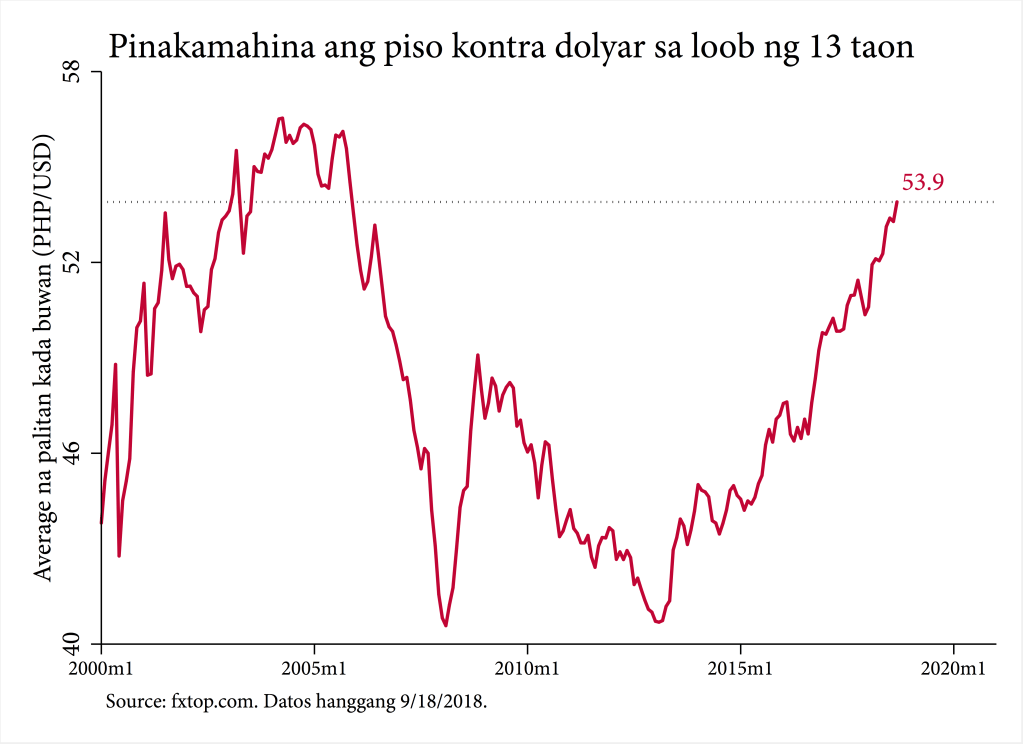
Kung ilalagay natin ito sa konteksto ng Pilipinas, ang kasalukuyang exchange rate ng piso kontra dolyar ay nasa 54 pesos na kada US dollar (USD). Ito na ang pinakamababang naitalang palitan sa nakalipas na 12 na taon (Figure 1).
Para sa kaalaman ng lahat, hindi naman bago sa atin ang paghina ng piso kontra dolyar.
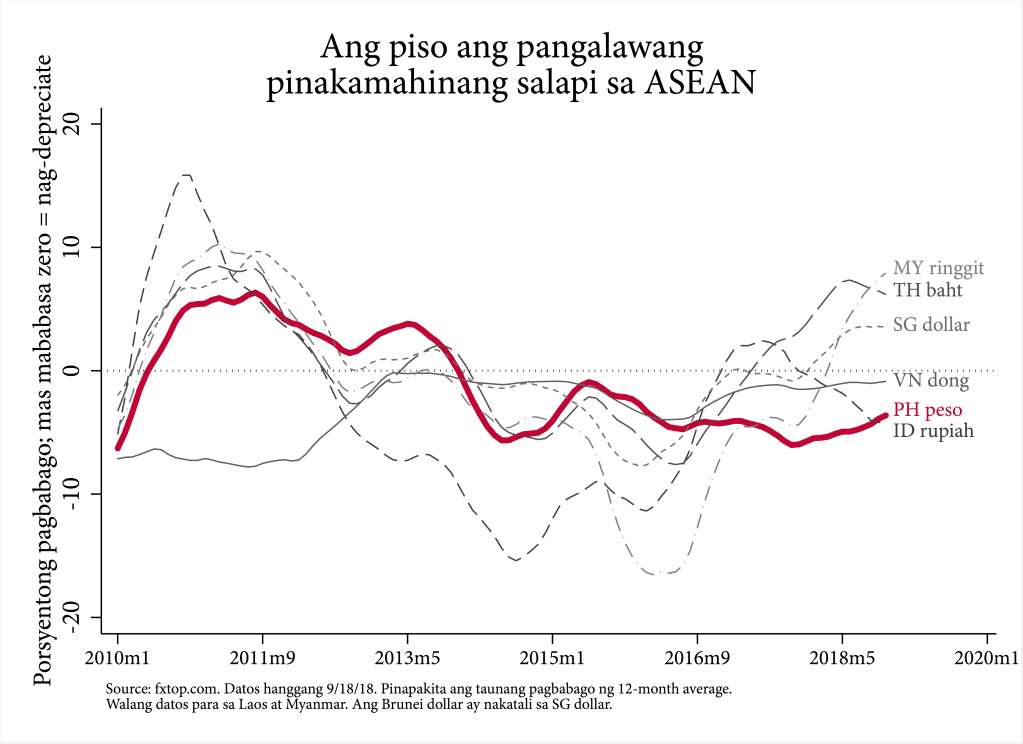
Sa katunayan, taong 2013 pa nagsimulang humina ang palitan ng piso kontra dolyar, sumabay ito sa paghina ng iba’t ibang currencies ng ating mga karatig-bansa sa rehiyong ASEAN.
Subalit noong 2016, nagsimulang makabawi ang karamihan sa kanila maliban sa Philippine peso (Figure 2). Kaya hindi totoo na isa lamang “global trend” ang pagbagsak ng halaga ng piso.
Bakit nagbabago-bago ang exchange rate?
Sa kasalukuyan, ang Pilipinas ay nagpapatupad ngfloating exchange rateregime, kung saan ang halaga ng piso laban sa dolyar ay nakadepende sa paggalaw ng kani-kanilang demand at supply sa merkado.
Halimbawa, kung bibili tayo ng imported goods sa US, nararapat lamang na ang perang ipambabayad natin sa bansang ito ay nasa US currency, o nasa dolyar.
Samakatuwid, ang labis na pag-aangkat (importation) ay nagiging sanhi ng mabilis na paglabas ng dolyar sa ating bansa. Ito’y nagdudulot ng pagbaba ng supply ng dolyar kumpara sa piso.
Ayon sa basic Economics, ang pagbaba ng supply ay nagiging dahilan ng pagtaas ng halaga ng isang bagay. Halimbawa, mas mahal ang presyo ng bigas kapag nagiging limitado ang supply nito tuwing may krisis o kalamidad.
Maari rin nating gamitin ang konseptong ito sa currencies. Kapag nagiging limitado o bihira ang supply ng dolyar kumpara sa piso, tumataas ang halaga nito laban sa piso, na magreresulta sa mas mababang palitan o ‘mataas’ na exchange rate.
Ayon mismo kay Budget Secretary Benjamin Diokno, ang pagbaba ng halaga ng piso ay dahil sa tumataas nating imports na dulot ng Build, Build, Build (BBB)—ang pangunahing programang pang-ekonomiya ng Administrasyong Duterte.
Ang mga proyektong kaakibat ng BBB ay nangangailangan ng mga materyales (gaya ng mga construction materials) na kailangan pa nating angkatin mula sa ibang bansa.
Masama ba o mabuti ang paghina ng piso?
Isa sa mga mabuting naidudulot ng ‘mataas’ na exchange rate ay ang pagtaas na halaga ng OFW remittances.
Kung nagpapadala ang tatay mong nasa California ng 1,000 USD kada buwan, ang pagtaas ng palitan mula 53 pesos patungong 54 pesos ay magbibigay sa iyo ng additional 1,000 pesos.
Bagamat maganda ang epekto ng tumataas ng exchange rate sa mga pamilyang umaasa sa remittances, dapat mo ding malaman na may epekto ito sa pagtaas ng presyo ng mga bilihin (inflation). (BASAHIN: Ano ang katotohanan sa inflation?)
Maraming sektor sa ating ekonomiya ang umaasa sa mga imported goods. Isa na siguro sa pinaka-apektado ng mataas na palitan ay ang sektor ng transportasyon. Pag humina ang piso, mas nagiging mahal ang mga produktong petrolyo sa pandaigdigang merkado, pati na rin ang gastos ng mga tsuper at driver, kaya asahan ang pagtaas ng mga pamasahe.
Isa rin sa madalas nating marinig na sinasabing magandang epekto ng ‘mataas’ na exchange rate ay ang posibleng pagtaas ng exports.
Base sa teorya sa Economics, kapag bumababa ang halaga ng domestikong salapi kumpara sa halaga ng banyagang salapi, nagiging mas mura ang mga produkto ng isang domestic country sa mata ng mga banyaga.
Isang magandang halimbawa nito ay ang China. Ilang beses nang pinaratangan ang China na sinasadya nilang pababain ang halaga ng Yuan para manatiling malakas ang kanilang exports.
Subalit kung titignan mo ang ating datos ng exports, makikita mong hindi naman lumalago masyado ang ating exports kahit na bumabagsak ang halaga ng piso (Figure 3).
Anong ibig sabihin nito? Na mali ang teorya sa economics? Hindi naman sa ganun, sapagkat may iba pang salik—tulad ng presyo at kalidad ng produkto—na maaring nakakaapekto sa malamlam nating exports sa pandaigdigang merkado.
Isa pang masamang naidudulot ng paghina ng piso ay ang pagtaas ng halaga ng ating utang panglabas (o ang ating external debt). Ayon sa Banko Sentral ng Pilipinas, ito’y umabot na sa 72.2 billion USD.
Samakatuwid, ang pagbaba ng exchange rate ay parehong mayroong positibo at negatibong epekto. Marahil ang kailangan lang nating pag-isipan ay kung anong epekto ang nangingibabaw at mas nararamdaman ng buong bansa.









 Storya Ni Juan Official