Nagbabala ang isang eksperto na ang mga taong lumalabas sa publiko na nakadamit tulad ng ibang kasarian ay maaaring maharap ng hanggang tatlong taon sa bilangguan sa ilalim ng bagong penal code ng Saudi Arabia.
Ayon kay Mohammed Al Wahaibi, legal na tagapayo sa Saudi TV Al Saudaih, ang sinumang gumagaya sa ibang kasarian sa pananamit, hitsura, at anyo ay mahaharap sa malupit na parusa.
Sa ilang mga kaso, ang pagsusuot ng damit na lumalabag sa pampublikong ugali at lumalabag sa moralidad ay maaaring maging isang krimen. Ayon sa mga regulasyon ng penal, ang kasuotan na nagmumungkahi ng panggagaya sa kababaihan ay ilegal.
Ito ay pinlano na maglabas ng isang bagong penal code sa lalong madaling panahon na tutugon sa imitasyon ng mga hitsura at pananamit ng isang kasarian ng isa pa.
Ang krimen ay hindi isang felony. Ito ay isang krimen na nagdadala ng maximum na sentensiya ng tatlong taon sa bilangguan,” aniya.
Ang lipunan ng Saudi ay kilala sa konserbatismo, mabuting moral at magandang hitsura, at hindi namin kukunsintihin ang anumang pag-aalipusta o pagbaluktot sa imaheng iyon.”
Ang mga bantay sa mga pampublikong lugar at palengke ay dapat lamang mag-ulat ng mga kaso ng cross-dressing, hindi arestuhin ang mga nagkasala, dahil responsibilidad iyon ng pulisya.
Ang ulat ay hindi nakatanggap ng agarang opisyal na tugon.
Referral of a citizen to the Public Prosecution Transfer and easy entry of an American non-Muslim journalist to the holy capital
The media spokesman of the Makkah Region Police stated that the region police referred to the Public Prosecution an accomplice citizen who transferred and facilitated the entry of one of the journalists (non-Muslims) and holds American citizenship to the Holy Capital through his behavior of the path of Muslims, in clear violation of the regulations prohibiting the entry of Mecca for non-Muslims, where he
The media spokesman of the Makkah Region Police noted to all those coming to the Kingdom the need to respect the regulations and abide by what they require, especially with regard to the Two Holy Mosques and the Holy Sites, and that any violation of this kind is a crime that will not be tolerated, and penalties will be applied to the perpetrators based on the relevant regulations. The case of the journalist who committed the crime has been referred to the Public Prosecution to take what is necessary against him in accordance with the regulations.
The Philippine Overseas Employment Administration (POEA) said that job seekers are not required to pay the placement fee for some jobs being offered abroad, according to Sandra Aguinaldo’s report on “24 Oras” on Tuesday.
POEA Administrator Bernard Olalia said the zero placement fee is applicable for jobs made available under a government-to-government agreement with some foreign countries.
Olalia said the government is looking at employment opportunities that will soon be available in “emerging markets” such as the United Kingdom, New Zealand, Germany, Canada, Australia, Taiwan, Romania, Croatia, and Hungary.
“Ang Israel ay nagsimula nang mag hire ng ating hotel workers… yung sa Australia isa itong another labor agreement pertaining to healthcare workers. According to them, mahigit isang libong healthcare workers ang kakailanganin natin,” he said.
(Israel started hiring our hotel workers… we have a labor agreement with Australia pertaining to healthcare workers. This will need more than a thousand healthcare workers.)
“Magpapadala rin ang bansang Pilipinas ng mga skilled and professionals natin papuntang Canada,” he added.
(The Philippines will also send our skilled workers and professionals to Canada.)
At the POEA office, several Filipinos bound for abroad were seen preparing for their requirements.
One of them was Frederick Bautista, who will return to South Korea as a worker in a furniture company.
Bautista was unemployed for a year due to the pandemic. But in June, his employer processed his application.
“Medyo malaki-laki po ang sinasahod ko sa ibang bansa. Para sa pamilya at kinabuksan ng mga anak ko.”
(I earn quite a lot abroad. This is for my family and the future of my children.)
Nurse Cyrell Anne de Leon is processing her document to go to Saudi Arabia.
De Leon said he does not want to be separated from her three children, but she has no other choice.
“Para sa future ng mga bata. Ang anak ko tatlo na at lumalaki na,” she said.
(This is for the future of my kids. I have three kids and they’re growing up.)
POEA said job opportunities abroad are opening up as more countries relax their COVID-19 restrictions.
Some of the jobs needed abroad are healthcare workers, factory workers, hotel staff, transportation and aviation staff.
The POEA, meanwhile, advised the public to always check their website for job openings overseas.
It also urged Filipinos to get training and upgrade their skills.
“Katuwang po ng departamento namin ang TESDA para sa patuloy na empowerment through the skills of our OFWs,” Olialia said.
(Our department is partnering with TESDA for the continuing skills empowerment of our OFWs.)—Mel Matthew Doctor/LDF, GMA News
The Philippine Overseas Employment Administration (POEA) said that job seekers are not required to pay the placement fee for some jobs being offered abroad, according to Sandra Aguinaldo’s report on “24 Oras” on Tuesday.
POEA Administrator Bernard Olalia said the zero placement fee is applicable for jobs made available under a government-to-government agreement with some foreign countries.
Olalia said the government is looking at employment opportunities that will soon be available in “emerging markets” such as the United Kingdom, New Zealand, Germany, Canada, Australia, Taiwan, Romania, Croatia, and Hungary.
“Ang Israel ay nagsimula nang mag hire ng ating hotel workers… yung sa Australia isa itong another labor agreement pertaining to healthcare workers. According to them, mahigit isang libong healthcare workers ang kakailanganin natin,” he said.
(Israel started hiring our hotel workers… we have a labor agreement with Australia pertaining to healthcare workers. This will need more than a thousand healthcare workers.)
“Magpapadala rin ang bansang Pilipinas ng mga skilled and professionals natin papuntang Canada,” he added.
(The Philippines will also send our skilled workers and professionals to Canada.)
At the POEA office, several Filipinos bound for abroad were seen preparing for their requirements.
One of them was Frederick Bautista, who will return to South Korea as a worker in a furniture company.
Bautista was unemployed for a year due to the pandemic. But in June, his employer processed his application.
“Medyo malaki-laki po ang sinasahod ko sa ibang bansa. Para sa pamilya at kinabuksan ng mga anak ko.”
(I earn quite a lot abroad. This is for my family and the future of my children.)
Nurse Cyrell Anne de Leon is processing her document to go to Saudi Arabia.
De Leon said he does not want to be separated from her three children, but she has no other choice.
“Para sa future ng mga bata. Ang anak ko tatlo na at lumalaki na,” she said.
(This is for the future of my kids. I have three kids and they’re growing up.)
POEA said job opportunities abroad are opening up as more countries relax their COVID-19 restrictions.
Some of the jobs needed abroad are healthcare workers, factory workers, hotel staff, transportation and aviation staff.
The POEA, meanwhile, advised the public to always check their website for job openings overseas.
It also urged Filipinos to get training and upgrade their skills.
“Katuwang po ng departamento namin ang TESDA para sa patuloy na empowerment through the skills of our OFWs,” Olialia said.
(Our department is partnering with TESDA for the continuing skills empowerment of our OFWs.)—Mel Matthew Doctor/LDF, GMA News
Magbubukas na ang 1-Repatriation Command Center ng Department of Migrant Workers (DMW) ngayong linggo.
Sa abiso ng DMW, ilulunsad ang 1-ORCC sa darating na Miyerkules sa tanggapan ng POEA sa Ortigas Avenue, Mandaluyong.
Ang naturang command center ang siyang magiging kauna-unahang Flagship Program ni DMW Secretary Susan Ople na layong magsilbing one-stop shop para sa pagaasikaso ng repatriation ng mga distressed OFW gayundin ang pagpapauwi ng labi ng mga nasawing migrant workers.
Inaasahang magbibigay ito ng kinakailangang tulong para sa mga OFW anuman ang kanilang employment status.
Makakatuwang naman ng DMW sa programa ang ilang government agencies gaya ng Department of Foreign Affairs (DFA) at Overseas Workers Welfare Administration (OWWA), pribadong sektor, at iba pang stakeholders.
Nauna nang sinabi ni DMW Secretary Susan Ople na nais nitong magkaroon ng iisang dudulugan ang mga pamilya ng OFWs na nangangailangan ng tulong sa ibang bansa.
MANILA, Philippines- Inanunsyo ng Overseas Workers Welfare Administration (OWWA) nitong Martes na inaprubahan ng board of trustees nito ang resolusyon na bubuo ng flagship program para sa proteksyon at kapakanan ng mga anak ng overseas Filipino workers.
Inihayag ng OWWA na sa Board Resolution Number 7 nito, inaprubahan ang OFW Children’s Circle (OCC) noong Hulyo 15 ng OWWA Board of Trustees sa pangunguna ni Department of Labor and Employment (DOLE) Secretary Bienvenido Laguesma, kasama si Department of Migrant Workers (DMW) Secretary Susan “Toots” Ople.
Nais ni Pangulong Ferdinand “Bongbong” Marcos Jr. na pagaanin ang buhay ng mga OFWat kanilang mga anak sa ilalim ng kanyang administrasyon.
Sinabi rin ng OWWA na tutulungan ng OCC ang mga anak ng OFW na ipakita ang kanilang mga kakayahan at talendo, pagbutihin ang kanilang social skills, mahasa ang kanilang coping mechanisms, at bigyan sila ng kaalaman sa youth-centered at civic advocacies kagaya ng environment at climate change, values reorientation, digital literacy, at anti-drugs at substance abuse.
“The OCC aims to help OFW children to achieve their full potential in community- and nation-building. It will also address the societal impact of labor migration, such as separation from an OFW-parent, as well as negative effects on their well-being and mental health,” pahayag ng OWWA.
“OCC programs and activities aim to help children cope with the negative effects and social costs of migration, not to mention the effects of the COVID-19 pandemic and other global emergencies,” dagdag nito.
Hindi bababa sa P15 milyon ang inilaan ng OWWA Board of Trustees fpara sa inisyal na implementasyon ng programa, na saklaw ang operational at administrative expenses nito.
Ayon pa sa OWWA, inisyal na ipatutupad ang OCC sa regional welfare offices sa National Capital Region, Ilocos Region, Calabarzon, Central Visayas, at Davao Region.
Susundan ito ng implementasyon ng programa sa lahat ng OWWA regional welfare offices. RNT/SA
The Ministry of Human Resources and Social Development (MHRSD) in Saudi Arabia has clarified the cases in which the domestic worker can transfer to another employer without obtaining the approval of the first employer.
1. It is proven that the employer of the domestic worker was late in paying the salary of the domestic worker for a period of 3 continuous or separate salaries without a reason attributed to the domestic worker.
2. Failure to receive the domestic worker from the intermediary recruitment office, or without accommodation, within 15 days from the date of being notified by the recruitment office of domestic worker arrival in the Kingdom.
3. Failure to get iqama (residence permit) for the domestic worker, or not renewing it even after 30 days specified from the date of issuance or renewal.
4. The home business owner renting the services of the domestic worker to others.
5. Evidence of that the domestic worker has been assigned to dangerous work that threatens his or her health or the safety of his body.
6. Proof of that the domestic worker or a family member of employer has mistreated.
7. The presence of a complaint by the domestic worker against the employer and the domestic employer has caused her to prolong her consideration, given that the domestic worker has not caused or contributed to the prolongation of the complaint as well.
8. The domestic employer has submitted an incorrect report of Huroob (Absent From Work) against the domestic worker.
9. Failure of the domestic employer or his representative to appear before the domestic service workers, dispute settlement committees for 2 hearings of which he is notified.
10. If it is proven that the services of the domestic worker have been transferred to another employer without his knowledge.
11. If the domestic employer is absent, either due to his travel, imprisonment, or any other reason, and this results in the inability to pay the domestic worker’s salaries.
Usap-usapan ngayon sa iba’t-ibang social media platforms ang exchange rate dahil sa pagbulusok ng halaga ng piso kontra dolyar.
Marahil marami ka na rin sigurong naririnig na kuro-kuro patungkol dito. May mga nagsasabing hindi ito maganda sapagkat nakakaapekto ito sa pagtaas ng presyo ng mga bilihin.
Meron din namang naniniwalang nakabubuti ito lalo na sa mga pamilyang umaasa sa perang padala o remittances ng mga kamag-anak nilang nasa abroad.
Subalit ano nga ba ang katotohanan sa likod ng pagbagsak ng halaga ng piso?
Ano nga ba ang exchange rate?
Ang exchange rate ay ang katumbas na halaga ng isang domestikong salapi laban sa isang banyagang salapi.
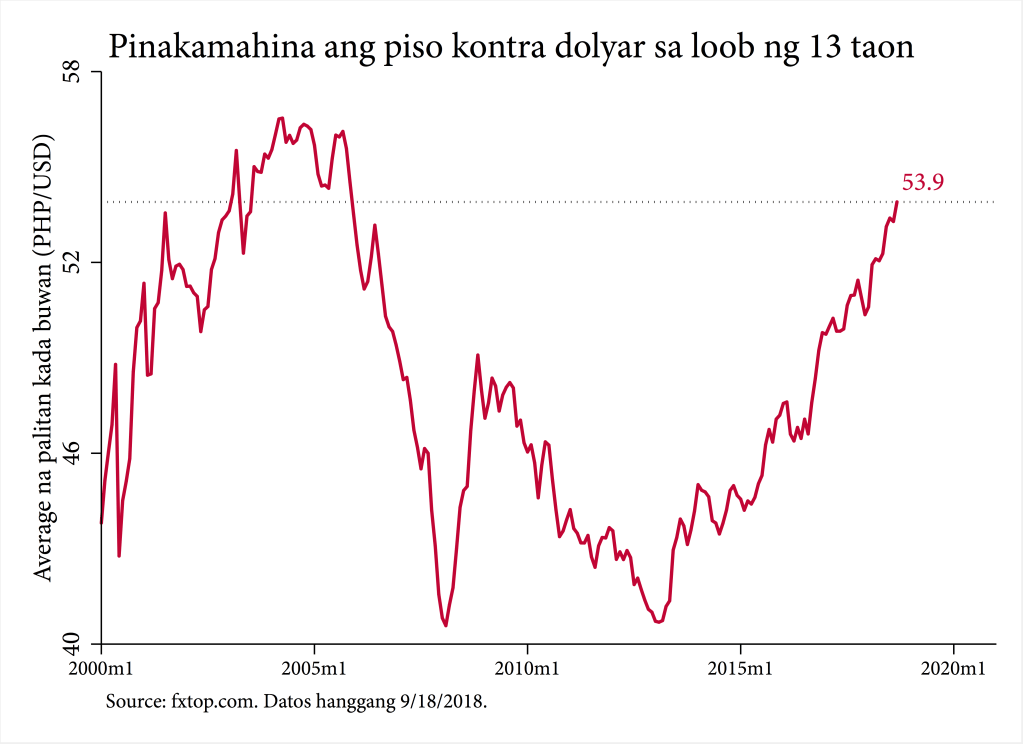
Kung ilalagay natin ito sa konteksto ng Pilipinas, ang kasalukuyang exchange rate ng piso kontra dolyar ay nasa 54 pesos na kada US dollar (USD). Ito na ang pinakamababang naitalang palitan sa nakalipas na 12 na taon (Figure 1).
Para sa kaalaman ng lahat, hindi naman bago sa atin ang paghina ng piso kontra dolyar.
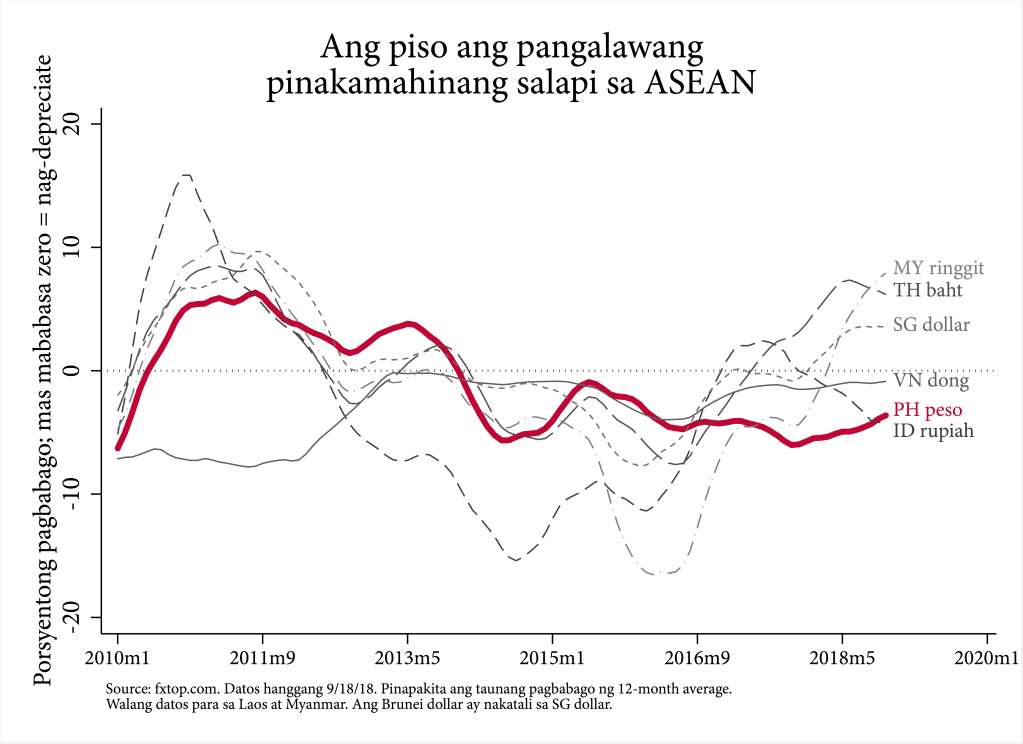
Sa katunayan, taong 2013 pa nagsimulang humina ang palitan ng piso kontra dolyar, sumabay ito sa paghina ng iba’t ibang currencies ng ating mga karatig-bansa sa rehiyong ASEAN.
Subalit noong 2016, nagsimulang makabawi ang karamihan sa kanila maliban sa Philippine peso (Figure 2). Kaya hindi totoo na isa lamang “global trend” ang pagbagsak ng halaga ng piso.
Bakit nagbabago-bago ang exchange rate?
Sa kasalukuyan, ang Pilipinas ay nagpapatupad ngfloating exchange rateregime, kung saan ang halaga ng piso laban sa dolyar ay nakadepende sa paggalaw ng kani-kanilang demand at supply sa merkado.
Halimbawa, kung bibili tayo ng imported goods sa US, nararapat lamang na ang perang ipambabayad natin sa bansang ito ay nasa US currency, o nasa dolyar.
Samakatuwid, ang labis na pag-aangkat (importation) ay nagiging sanhi ng mabilis na paglabas ng dolyar sa ating bansa. Ito’y nagdudulot ng pagbaba ng supply ng dolyar kumpara sa piso.
Ayon sa basic Economics, ang pagbaba ng supply ay nagiging dahilan ng pagtaas ng halaga ng isang bagay. Halimbawa, mas mahal ang presyo ng bigas kapag nagiging limitado ang supply nito tuwing may krisis o kalamidad.
Maari rin nating gamitin ang konseptong ito sa currencies. Kapag nagiging limitado o bihira ang supply ng dolyar kumpara sa piso, tumataas ang halaga nito laban sa piso, na magreresulta sa mas mababang palitan o ‘mataas’ na exchange rate.
Ayon mismo kay Budget Secretary Benjamin Diokno, ang pagbaba ng halaga ng piso ay dahil sa tumataas nating imports na dulot ng Build, Build, Build (BBB)—ang pangunahing programang pang-ekonomiya ng Administrasyong Duterte.
Ang mga proyektong kaakibat ng BBB ay nangangailangan ng mga materyales (gaya ng mga construction materials) na kailangan pa nating angkatin mula sa ibang bansa.
Masama ba o mabuti ang paghina ng piso?
Isa sa mga mabuting naidudulot ng ‘mataas’ na exchange rate ay ang pagtaas na halaga ng OFW remittances.
Kung nagpapadala ang tatay mong nasa California ng 1,000 USD kada buwan, ang pagtaas ng palitan mula 53 pesos patungong 54 pesos ay magbibigay sa iyo ng additional 1,000 pesos.
Bagamat maganda ang epekto ng tumataas ng exchange rate sa mga pamilyang umaasa sa remittances, dapat mo ding malaman na may epekto ito sa pagtaas ng presyo ng mga bilihin (inflation). (BASAHIN: Ano ang katotohanan sa inflation?)
Maraming sektor sa ating ekonomiya ang umaasa sa mga imported goods. Isa na siguro sa pinaka-apektado ng mataas na palitan ay ang sektor ng transportasyon. Pag humina ang piso, mas nagiging mahal ang mga produktong petrolyo sa pandaigdigang merkado, pati na rin ang gastos ng mga tsuper at driver, kaya asahan ang pagtaas ng mga pamasahe.
Isa rin sa madalas nating marinig na sinasabing magandang epekto ng ‘mataas’ na exchange rate ay ang posibleng pagtaas ng exports.
Base sa teorya sa Economics, kapag bumababa ang halaga ng domestikong salapi kumpara sa halaga ng banyagang salapi, nagiging mas mura ang mga produkto ng isang domestic country sa mata ng mga banyaga.
Isang magandang halimbawa nito ay ang China. Ilang beses nang pinaratangan ang China na sinasadya nilang pababain ang halaga ng Yuan para manatiling malakas ang kanilang exports.
Subalit kung titignan mo ang ating datos ng exports, makikita mong hindi naman lumalago masyado ang ating exports kahit na bumabagsak ang halaga ng piso (Figure 3).
Anong ibig sabihin nito? Na mali ang teorya sa economics? Hindi naman sa ganun, sapagkat may iba pang salik—tulad ng presyo at kalidad ng produkto—na maaring nakakaapekto sa malamlam nating exports sa pandaigdigang merkado.
Isa pang masamang naidudulot ng paghina ng piso ay ang pagtaas ng halaga ng ating utang panglabas (o ang ating external debt). Ayon sa Banko Sentral ng Pilipinas, ito’y umabot na sa 72.2 billion USD.
Samakatuwid, ang pagbaba ng exchange rate ay parehong mayroong positibo at negatibong epekto. Marahil ang kailangan lang nating pag-isipan ay kung anong epekto ang nangingibabaw at mas nararamdaman ng buong bansa.
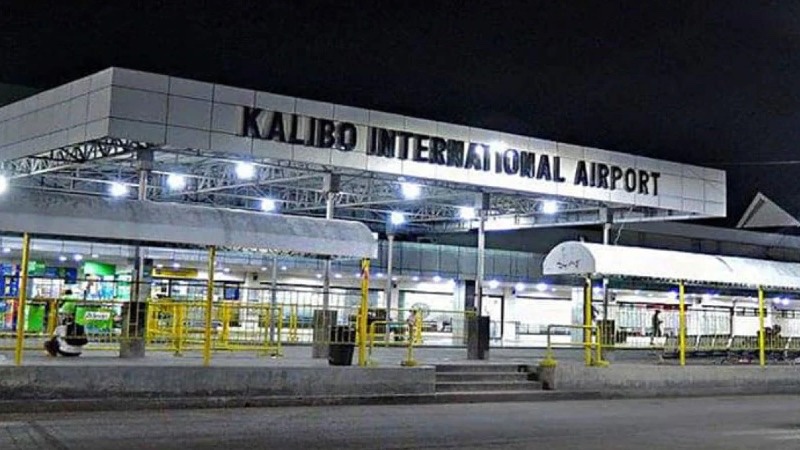
ILOILO City– Balik na ang pagtanggap ng international flight sa Kalibo International Airport na nagsisilbing gateway patungo sa sikat na Boracay Island sa Aklan sa unang pagkakataon sa loob ng mahigit dalawang taon.
Inanunsyo ng Civil Aviation Authority of the Philippines (CAAP)-Kalibo na ipinagpatuloy ang direct international flights sa airport nang lumapag ang isang Air Seoul flight mula Incheon, South Korea noong Biyernes ng gabi.
“Hala Bira! at isang mainit na pagtanggap sa pagbabalik!” saad ng CAAP-Kalibo sa opisyal nitong Facebook page.
Sinimulan ni Aklan Gov. Florencio Miraflores noong nakaraang Disyembre ang panukalang pagpapatuloy ng mga international flights sa Kalibo Airport. Ngunit ang banta ng variant ng Omicron ng Covid-19 ay humadlang.
Wala ring nangyari noong Pebrero 10 nang payagan ng pambansang pamahalaan na bumisita sa bansa ang mga turistang internasyonal na ganap na nabakunahan.
Ang mga dayuhang turista na gustong pumunta sa Boracay Island sa Malay ay kailangan pang lumipad patungong Maynila at sumakay ng connecting flight papuntang Kalibo Airport.
Ang mga direktang internasyonal na flight ay nakikitang magdadala ng mas maraming turista mula sa South Korea na kabilang sa mga nangungunang dayuhang bisita sa pinakasikat na destinasyon sa beach ng bansa.
Nasa 2,439 na dayuhang turista lamang ang bumisita sa Boracay mula Hunyo 1 hanggang 15.
Bukod sa South Korea, mayroon ding mga direktang flight mula sa China at Taiwan bago ang pandemya na nagsimula noong Marso 2020. RNT







 Storya Ni Juan Official